



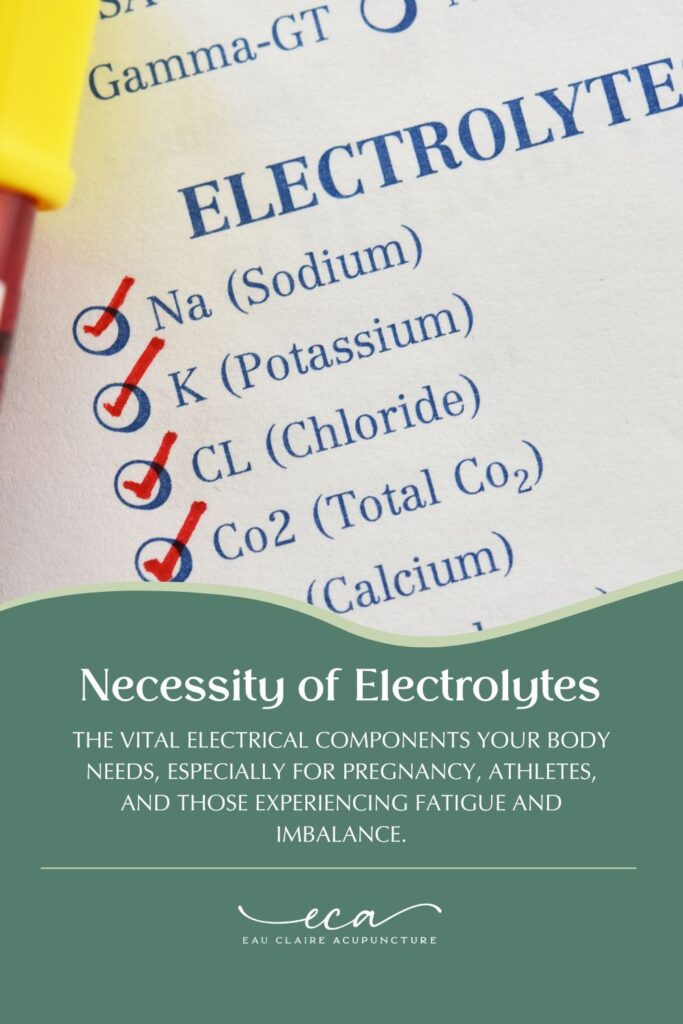
The vital electrical components your body needs, especially for pregnancy, athletes, and those experiencing fatigue and imbalance.
Electrolytes are not just ‘chemicals’ that your body takes up like vitamins, but rather ions, carrying an electrical charge, that allow your body to move electrical signals through your tissues and systems. This means that electrolytes are essential to how your body moves, signals, communicates, and subsequently executes tasks. This could be as simple as allowing a signal to move across a cell membrane, activating an intercellular cascade of chemicals, or a multi-step process such as allowing a muscle to move.
In simpler terms, electrolytes help your body send messages so your muscles move, your brain focuses, and your energy stays steady throughout the day. When these minerals are low, those messages slow down, which is often why people feel tired or sluggish.
At Eau Claire Acupuncture, we focus on electrical health, because that’s what acupuncture is all about! Acupuncture supports electrical communication through stimulating nerves, helping to activate your body’s natural healing processes. Not only is acupuncture a great way to address electrical communication in the body, but nutrition can also be an important supporting factor in its proper functioning. This is because your body needs both the electrical and chemical components of electrolytes to execute tasks.
Your body is a massive communication highway, where every cell is communicating within itself, with the smaller cellular signals working to trigger big picture signals. Each signal requires energy (a charge, either + or -) and chemicals (such as Cl, K, and Ca) to send the message.
Think of it like this: your body can drink water and eat food, but without these minerals, your cells can’t actually use that fuel the way they’re supposed to. This is why someone can hydrate all day and still feel dehydrated or drained.
The chemicals are the actual particle (Cl, for example) and the energy is the charge that it carries (Cl-). The body is dependent upon both the charge and the presence of that chemical in order to execute functions. This is because the presence of positive or negative charges inside or outside a cell creates a membrane potential (think of it as potential energy).
When your cells can’t communicate well, your body often shows it through symptoms like headaches, low energy, irritability, or feeling out of balance. These are early signs your system is working harder than it should.
Acupuncture focuses on stimulating these electrical communication cascades, but it needs the right chemical components to ensure that the message gets sent properly. That’s why we have partnered with our integrative nutritionist, Grace, to go over the necessity of electrolytes for one’s electrical health, so you have the building blocks for healthy electrical communication and balance.
Acupuncture helps turn the body’s electrical signals back on, and electrolytes help those signals stay clear and consistent between treatments. Together, they support healthier communication pathways throughout the body.
What are electrolytes?
Electrolytes are ions, which are particles that carry an electrical charge. They are: sodium, potassium, chloride, magnesium, calcium, phosphate, and bicarbonates (Shrimanker & Bhattarai, 2019). Our bodies need electrolytes because they allow our cells to communicate electrically. If there are not enough ions in the fluids in and out of our cells, there isn’t enough electrical potential to activate communication signals.
To make it easier, electrolytes are minerals your body uses to create electricity — without them, everything from muscle movement to mood can feel off. Even small shifts in these minerals can affect how your body feels and functions.
That’s why you might experience muscle twitching if your electrolyte balance is off, as your cells begin to fire imbalanced electrical communication due to the concentrations of ions in and out of your cells being off.
Electrolytes not only impact common processes such as muscle contraction and relaxation, but are also involved in immune response and gene activation, as their concentrations affect the communication to turn on and off these processes (Kaestner, 2025). They also impact the body’s enzyme activity and hormone secretion (Nickless & Hindley, 2022).
Simply put, these minerals influence everything from how your muscles move to how your hormones function, which is why low electrolytes can create symptoms that don’t seem connected at first.
So, electrolytes are essential to just about everything your body needs to accomplish!
Do I need electrolytes?
Diet plays a large role in electrolyte consumption and deficits in the US. Furthermore, an individual’s activity or health status can also impact electrolyte balance; athletes or those exerting strain on muscles at work, or those taking certain medications, may be at more of a risk for electrolyte imbalance (Shrimanker & Bhattarai, 2019).
Generally, individuals in the US consume excess sodium but are lacking in potassium, calcium, and magnesium (Karppanen, 2005). This is because most Americans consume a processed diet, which lacks certain minerals and contains others in excess. Sodium can often be high due to processed foods; however, individuals avoiding sodium as a preventative measure may inadvertently reduce their sodium level enough to create symptoms like fatigue.
Most people don’t get enough of the minerals that support energy and muscle function, which can lead to symptoms that seem unrelated, like which can lead to symptoms that seem unrelated, like fatigue, headaches, brain fog, irritability, or muscle tightness. Balancing them often brings quick relief because your body finally gets what it’s been missing.
Generally, we like to recommend electrolyte supplementation based on your diet, activity levels, and symptomatic concerns. Having an appropriate electrolyte balance and addressing electrolyte deficiencies can help with your overall electro-physiological health.
Curious if your symptoms might be related to electrolytes; book your consultation today to talk over your symptoms and get a Traditional Chinese Medicine perspective.
Can electrolytes impact mood?
Electrolytes have been found to be associated with mood, with electrolyte depletion disorders having many of the same symptoms as depressive conditions. For example, clinically low sodium is often marked with symptoms such as lethargy, weakness, irritability, or headaches (Sawant, 2019). These symptoms can often be misdiagnosed as depression, leaving important electrolyte imbalances unchecked due to the mood-related symptoms being the chief complaints of the patient.
Depending on the individual, different diets associated with varying electrolyte levels can affect mood outcomes (Torres, 2008). At Eau Claire Acupuncture, we like to look at the full picture and recommend dietary changes or electrolyte supplementation based on your symptoms.
Sometimes what feels like stress, irritability, or low mood is actually your body signaling that it needs better mineral and hydration support. When the foundational minerals are restored, many emotional symptoms improve as well.
Furthermore, the body is great at eliminating electrolytes, rather than keeping them, so taking electrolytes is generally low-risk. Especially due to general dietary deficiencies in electrolytes, testing an electrolyte beverage can be a great first step to address symptoms and rule out imbalances or find relief.
Electrolytes for pregnancy?
During pregnancy, not only do one’s nutritional needs increase, but so do their hydration needs. Because electrolytes pull water where it’s needed, they are essential to proper hydration.
During pregnancy, one’s need for fluid increases, as total blood volume goes up by around 40-50% (Vinturache, 2021). Water is also needed to exchange between the mother and the fetus, with a mother’s fluid intake impacting the amount of amniotic fluid that surrounds the baby (McKenzie et al., 2017).
Furthermore, during breastfeeding, women who exclusively breastfeed have been found to be the most at risk for dehydration (Malisova et al., 2024). This is because breastfeeding results in additional water loss, which can be up to 700 ml per day (Neville, 1988). Plus, the birthing process itself can result in dehydration, accompanied by sweating and muscle exertion, leading to water depletion risk even before breastfeeding begins.
Just drinking plain water in order to rehydrate can often lead to sodium plasma levels being depleted, which can manifest as lightheadedness, fatigue, or headaches. Supplementing with electrolytes can help to combat the risk of dehydration after pregnancy and during breastfeeding. We have listed out electrolytes we recommend and are safe for pregnant or breastfeeding women below.
Electrolytes help your body stay hydrated in a way plain water can’t, which is especially important when your fluid needs go up during pregnancy and breastfeeding. They help ensure both you and your baby get the support needed during these higher-demand times.
What electrolytes should I buy?
Qualities of a Good Electrolyte Drink
- Contains very minimal or no added sugar
- No artificial dyes or neon colors
- No artificial sweeteners (sucralose, acesulfame potassium, aspartame)
- Minimal additives: avoid preservatives, anti-caking agents, and “natural flavors” if possible
- Balanced electrolyte profile: sodium + potassium + magnesium
- Ideally naturally flavored or lightly sweetened (stevia/monkfruit if tolerated)
Qualities of a Poor Electrolyte Drink
- High sugar content (10–35 g per bottle, sometimes more)
- Artificial dyes (Blue 1, Red 40, Yellow 5)
- Artificial sweeteners linked to gut imbalance
- “Energy” additives like caffeine or stimulants (unnecessary for hydration)
- More sugar than electrolytes
Electrolytes should hydrate, not spike blood sugar, irritate the gut, or burden your body with additives.
Clean & High-Quality
- LMNT
- Redmond Re-Lyte
- Jigsaw Electrolyte Supreme
- Trace Minerals Power Pak (stevia version)
- Just Ingredients Electrolyte
- Live It Up
- Nutridyn Hydrate
- Vega Sport Hydration
- Hi-Lyte / Keto K1000
- Nectar Hydration
- Ultima Replenisher
- Sports Research Hydrate Electrolytes
Brands to Avoid
- Gatorade (all standard & Frost lines)
- Gatorade Zero & G2 (contain sucralose + dyes)
- Powerade
- Powerade Zero
- BodyArmor (high sugar)
- Liquid I.V. (very high sugar + flavorings)
- Prime Hydration
- Pedialyte (all standard versions — high sugar, artificial sweeteners)
- Pedialyte AdvancedCare (sucralose + dyes)
- Propel (sucralose + flavorings)
- Vitaminwater (high sugar + additives)
- Sqwincher (industrial hydration drink — dyes + sucralose)
- Accelerade / Endurox (artificial flavors + carbs)
- DripDrop Zero Sugar
Interested in learning if electrolytes might benefit you?
Book your BioScan today and take the first step toward fulfilling your nutrition needs and learning exactly what your body is asking for!
Interested in understanding how your electrical health contributes to whole wellness? Book your acupuncture consultation today, where we use the AcuGraph scan to assess energetic balance in your body.
Written by: Leandra O’Connell
References
Kaestner, L. (2025). Special Issue “Ion Conductance and Ion Regulation in Human Health and Disease”. International Journal of Molecular Sciences, 26(21), 10650. https://doi.org/10.3390/ijms262110650.
Karppanen, H., Karppanen, P., & Mervaala, E. (2005). Why and how to implement sodium, potassium, calcium, and magnesium changes in food items and diets?. Journal of Human Hypertension, 19(3), S10–S19. https://doi.org/10.1038/sj.jhh.1001955
Malisova, O., Apergi, K., Niaos, E., Xenaki, F., & Kapsokefalou, M. (2024). Investigating Water Balance as a Nutritional Determinant in Breastfeeding: A Comparative Study of Water Consumption Patterns and Influencing Factors. Nutrients, 16(13), 2157. https://doi.org/10.3390/nu16132157
McKenzie, A. L., Perrier, E. T., Guelinckx, I., Kavouras, S. A., Aerni, G., Lee, E. C., … & Armstrong, L. E. (2017). Relationships between hydration biomarkers and total fluid intake in pregnant and lactating women. European Journal of Nutrition, 56(6), 2161–2170.
Neville, M. C., Keller, R., Seacat, J., et al. (1988). Studies in human lactation: milk volumes in lactating women during the onset of lactation and full lactation. American Journal of Clinical Nutrition, 48, 1375–1386.
Nickless, G., & Hindley, B. (2022). Electrolyte disturbances: causes and management. Pharmaceutical Journal, 309(7964). ISSN 2053-6186.
Sawant, N. S., Parkar, S. R., Rupani, K., Bansal, H., & Singh, S. (2019). Hyponatremia misdiagnosed as depression. Annals of Indian Psychiatry, 3(2), 168–170.
Shrimanker, I., & Bhattarai, S. (2019). Electrolytes.
Torres, S. J., Nowson, C. A., & Worsley, A. (2008). Dietary electrolytes are related to mood. British Journal of Nutrition, 100(5), 1038–1045.
Vinturache, A., & Khalil, A. (Year unavailable). Global Library of Women’s Medicine. ISSN: 1756-2228; DOI: 10.3843/GLOWM.411323.